
about us
premise & philosophy
Forever Lab is a research laboratory, creative studio, and field-building institution at Stanford. We cultivate new forms of collective practice and institutional imagination that meet this era of profound change.
what guides us
our Mission
Forever Lab is built on a simple premise: As humanity enters a new era, we require novel ways of investigating humanity’s enduring questions.
Such questions will require forms of collective practice that move beyond familiar dualities—science and art, humanity and technology, natural and artificial, thinking and doing. We believe transformative breakthroughs emerge when people who rarely work together pursue a shared question over time. Forever Lab is building the institutional infrastructure needed for those forms of collaboration to flourish.
what shapes us
our lineage
Forever Lab engages questions of global importance while emerging from a distinct, place-based lineage of cross-disciplinary innovation.
We are rooted in the San Francisco Bay Area, where artists, technologists, and scientists have long benefited from our cross-pollination. From early experiments in media art and human–computer interaction to the development of immersive and networked technologies, this region has fostered a culture of exchange across disciplines. We draw inspiration from institutions such as Bell Labs and Xerox PARC, where breakthroughs emerged through sustained dialogue across fields.
We see our work as a contemporary extension of that tradition, reactivating the art–science-humanity interface to address enduring questions in human life.
What Guides Us
These principles articulate the intellectual and ethical commitments that guide how the lab operates.
They shape how questions are framed, how collaborations are structured, and how knowledge moves from investigation to real-world integration. Each principle functions as a methodological anchor within a larger, integrated system.
Questions First
We begin with questions rather than predetermined solutions or disciplinary boundaries. The questions determine who belongs in the room, and what practices and expertise they bring.
Institutional Imagination
Every era creates opportunities to imagine new ways of organizing inquiry. We treat fellowships, research initiatives, public experiences, and partnerships as experiments in institutional design.
translational field-building
Our goal is not simply to produce projects, but to expand the capacity of institutions, communities, and cultures to investigate these questions long after individual initiatives conclude.
interdisciplinary parity
Artists, scientists, technologists, clinicians, humanists, and communities each illuminate different dimensions of a given question. We cultivate environments where these traditions investigate together.
Creation as Inquiry
Knowledge is generated through many forms of practice. Research, performance, design, storytelling, prototyping, and public engagement are all legitimate modes of investigation.
our origin story
How Forever Lab Began
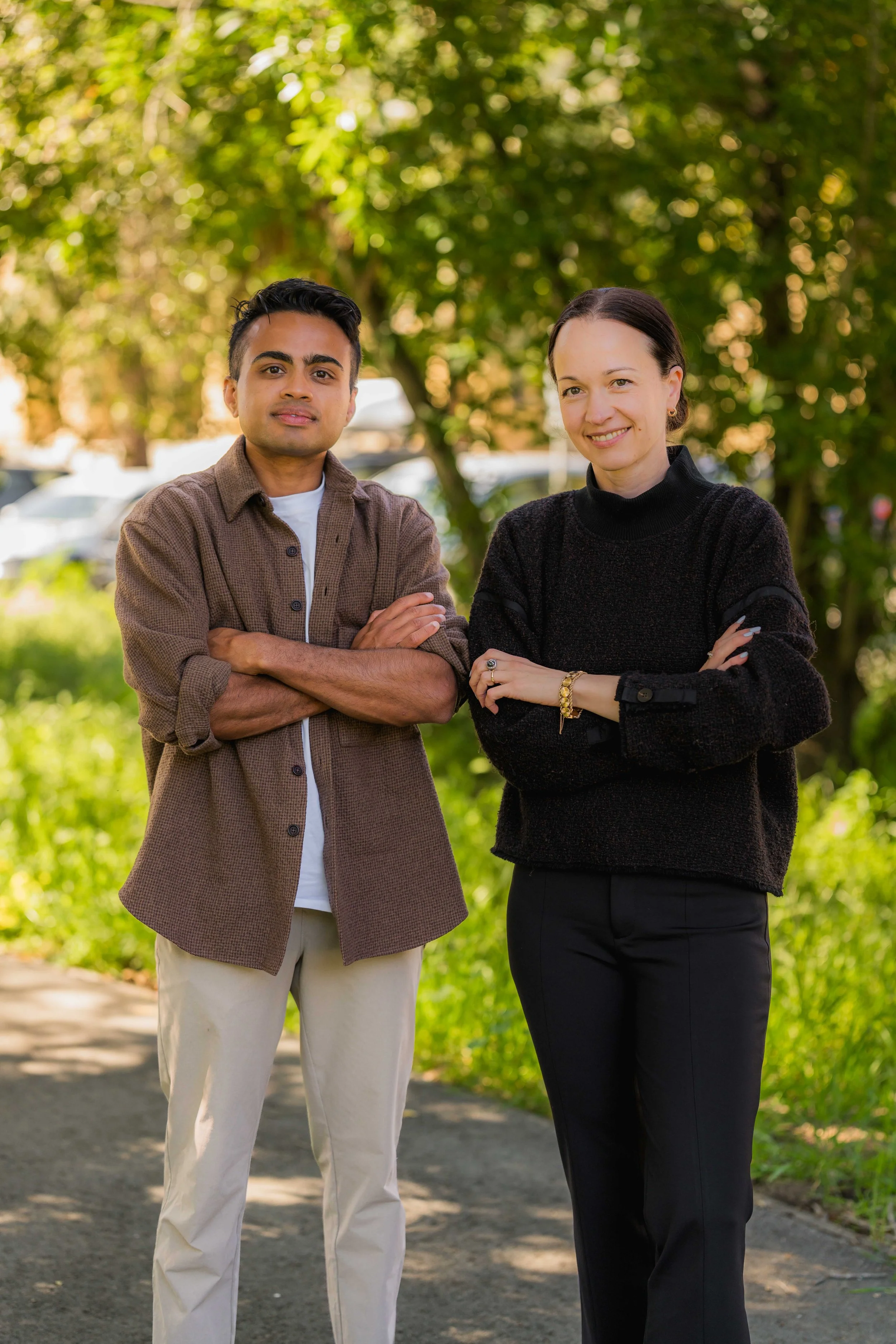
Forever Lab was founded through a collaborative partnership between Janani Balasubramanian and Dr. Karleen Giannitrapani.
Karleen brings decades of experience leading health services research and systems-level innovation alongside a formative background as a dancer and choreographer. Janani is an award-winning artist and director whose boundary-pushing work has been supported and presented by such institutions as the Sloan Foundation, MacArthur Foundation, Sundance Institute, and the American Academy in Rome, among others.
Through their early collaboration, they recognized that many of the defining questions of our era—care, loss, imagination, emerging technology, and collective life—naturally invited new configurations of shared practice, yet few institutional environments were designed to sustain that inquiry over time. They saw an opportunity to build a new kind of institutional home: one that organized inquiry around fundamental questions rather than disciplinary boundaries.
Today, Forever Lab serves as both a research institution and a living experiment in institutional imagination. We believe institutions are creative materials that can evolve alongside society, creating the conditions for unusual teams of practitioners to do extraordinary work.